Sunday, 27 November 2011

Butterflies of Tampines Eco Green

Hi, it's been a while since I last posted, but I have more time
now so I should be updating my blog more often. :) Today
I have a write up on the butterflies of the Tampines Eco Green.
It is a eco- friendly park, with secondary forest, grass and
shrub land, and freshwater habitats. It boasts over 15 species
of dragonflies, 70 birds and many butterflies! At the entrance,
many pea plants have been planted. The peas attract many danainae
( tigers and crows ) butterflies. They like to feed on the dried seed
pods. Below is a dark glassy tiger.

The pea plants are also the caterpillar host plants of the
pea blue. The pea blues are very common in the park and often flutter
close to the ground.

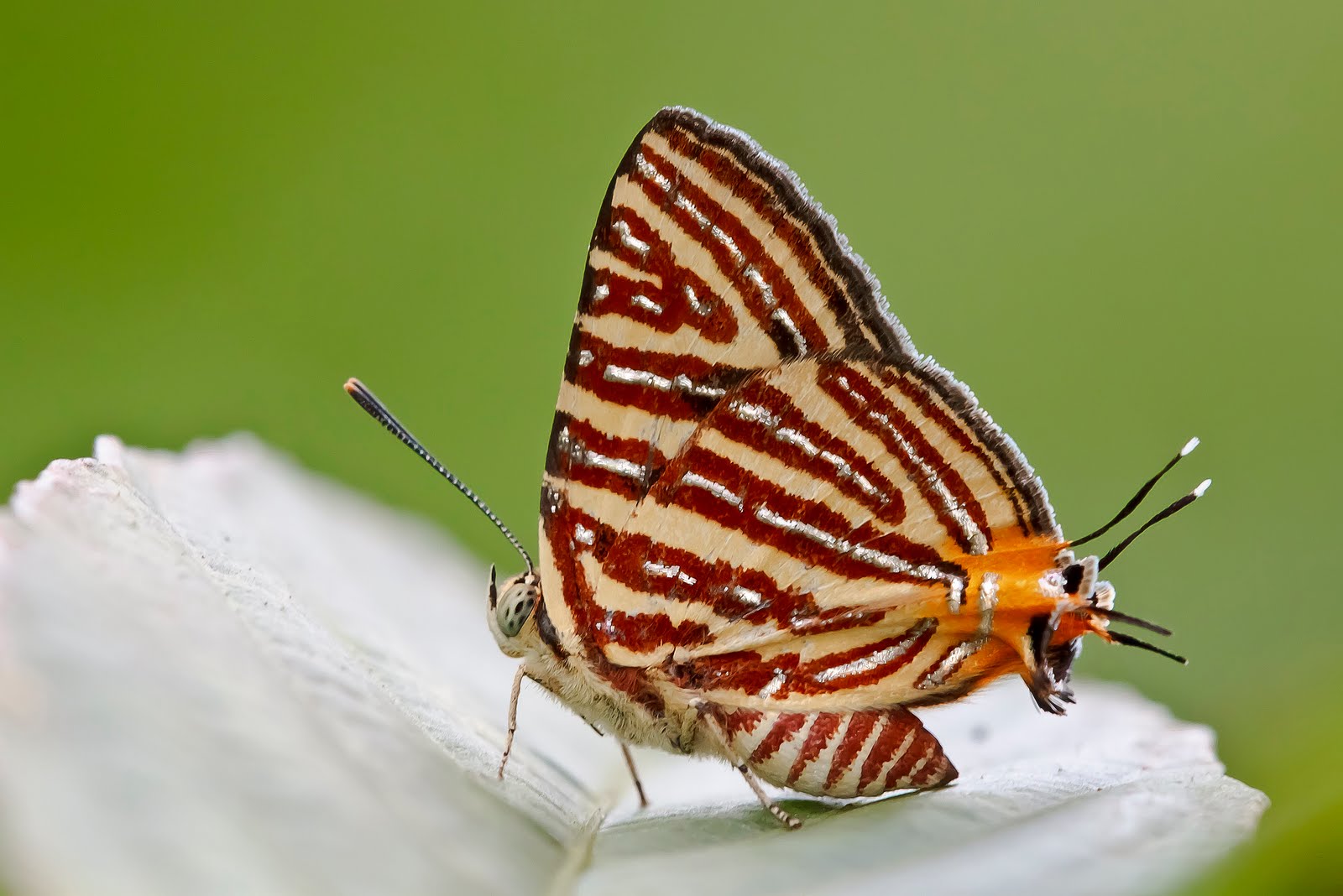
At the park you can also find the two silverline species there.
The hostplant, the acacia auriculiformis, grows abundantly
around the grasslands. Both of them are rapid fliers. This is a
club silverline.

This one is a long banded silverline.

The leea rubra plants that grow along the edge of the lake
have attracted many species of butterflies to visit too. Look
out for the glassy tigers, plain and common tigers, common mime,
grass yellows and other surprise visitors! This conjoined swift
is taking a sip from one of the small flowers.
And here is a palm dart resting on the flower buds.

You can also see tawny costers at the grassland areas.
They flutter slowly in the wind and are a joy to watch.
Their host plant, a passionflower called passiflora foedita
grows in the wooded spots.
There are so many more butterflies to see at the Tampines
Eco Green and on a sunny day at least 15 species can be spotted.
The park has an area of 36.5 hectares and is wedged between the
Sungei Tampines Canal, the Tampines Expressway and the
Tampines ave 12. There are plenty of ways to get there but there
is no car park.
It is definitely worth a visit

Thursday, 3 November 2011

The Oh' Farms Butterfly Lodge V 2.0


In August 2008, a small butterfly aviary was opened
in the Oh' Farms in Sembawang. The lodge served as a
classroom for many schools, whose students went on
trips there to learn about butterflies. It was very successful,
and now it is bigger and better than ever!

The butterfly lodge houses many common urban
butterflies and now many new ones have been added.
The newly 'renovated' aviary is more than twice the size of
the original. It is also taller to provide an even more
spacious environment for the butterflies and for the people.

There are many species of butterflies flying happily
inside the lodge. Mottled emigrants, common grass yellows
leopard lacewings thrive. The lodge also offers many other
butterflies, such as blues ( lycaenidae ) and even skippers
( hesperiidae ) can be found. This is wonderful as not
many butterfly farms house these butterflies. Of
course there are the large showy species too!
The aviary is also filled with lush foliage. Butterfly host
plants and nectaring plants make up the bulk of them, but
filler plants have been added too. Bidens plants cover the main
planters with their lovely flowers and are a favourite among the
butterflies.
The lodge is definitely worth a visit and you will keep
coming back for more! The entrance fee is only $4, for an
unlimited time inside to enjoy the butterflies!
There is also a great variety of species there, here is a list,
but do bear in mind that there may always be more additions:

.common mime
.common mormon
.lime butterfly
.mottled emigrant
.lemon emigrant
.orange emigrant
.cabbage white
.striped albatross
.common grass yellow
.dingy bush brown
.plain tiger
.leopard lacewing
.the leopard
.autumn leaf
.chocolate pansy
.peacock pansy
.blue pansy
.pea blue
.potanthus species (skippers)

The Oh' farms are located within the Nee Soon
Agrotechnology Parks. The address is 14A, Bah Soon Pah Road,
(Sembawang ). The butterfly lodge is nestled right near the
entrance. Do visit it!!! :)

(pic no. 1: leopard lacewing
2: lime butterfly
3: blue pansy
4: chocolate pansy
5: striped albatross
6: common mormon
7: plain tiger)


The End.

Saturday, 17 September 2011

Oriental Pied Hornbill

Back in late 2008, The long- lost oriental pied hornbill
recolonised in Pulau Ubin, after many years of absence
from Singapore. Shortly after, in early 2009, sightings of
the bird spread to the mainland. Most of them were at Changi.
I did see a pair there, in that same year. But now 3 years later
the hornbill is very widespread here.
Every morning, about 9 - 9.30 am, a noisy group of
4- 6 birds would gather in the trees at Upper Seletar reservoir-
which is all the way to the North of Singapore! Though they
stay high up in the canopies, they are easily heard and
located. A very good spot to look for them is right at the
car park (B) ! A group of 4 oriental pied hornbills gather
in the rain trees directly above the car park.
In fact, the hornbills have spread even more recently
and there have been sightings of them in Bukit Timah,
in the centre of Singapore. The birds seem to be doing
pretty well and they are surely getting more common.
The reason this species is able to recolonise here
in Singapore where it previously went extinct is probably
that it is adaptable. It is one of the only hornbills that does
not require a pristine forest habitat. However, others that
live in Malaysia and Borneo are very vulnerable to global
extinction : if the forests disappear, they will vanish too.. ...

Friday, 9 September 2011

Aristolochia Tagala and the Common Birdwing

I'm back with my latest painting, which features a vine
called aristolochia tagala and it features the common
birdwing ( troides helena ).

The common birdwing is the second largest
butterfly in Singapore and the females easily take
on a wingspan of 180 mm. It is a CITES protected
butterfly, as all other troides species. In Singapore it
is uncommon but always stays around its hostplant,
aristolochia acuminita , but may also use a. tagala.
The painting is in oils on a 11 by 14 inch canvas and all
the elements are life sized.

the End.